

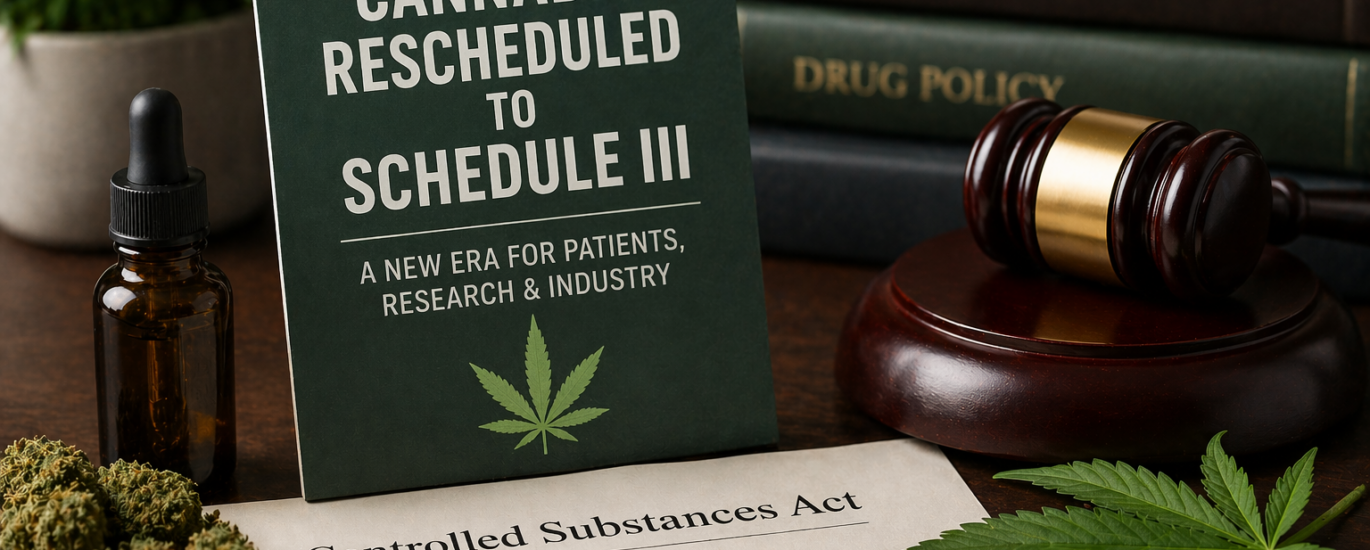
The United States has entered a new era of cannabis policy. The federal government has officially reclassified regulated medical cannabis from Schedule I to Schedule III under the Controlled Substances Act, marking the most significant shift in more than five decades of drug regulation.
While this move does not legalize cannabis nationwide, it fundamentally changes how the federal government defines the plant. For the first time since 1970, cannabis is no longer being treated as a substance with “no accepted medical use” at the federal level.
The implications reach far beyond Washington.
A Historic Shift in Federal Policy
For more than 50 years, cannabis remained in Schedule I, alongside substances like heroin, reflecting the federal government’s position that it had no accepted medical value and a high potential for abuse.
Meanwhile, the reality across the country evolved in a completely different direction. Today:
- More than 40 states have legalized medical cannabis
- Millions of patients rely on it for treatment
- A growing body of research supports therapeutic applications
- Legal adult-use markets operate in multiple states
The Schedule III reclassification formally acknowledges this disconnect.
It does not remove federal restrictions on recreational cannabis, but it does recognize medical cannabis as a substance with accepted medical use and lower relative risk classification.
That change alone reshapes the legal and scientific framework surrounding the entire industry.
What Schedule III Actually Changes
The shift to Schedule III carries practical consequences that directly affect businesses, researchers, and patients.
1. Tax Relief Through 280E Reform
One of the most immediate impacts involves IRS Code 280E, which previously prevented cannabis businesses from deducting ordinary operating expenses.
Under Schedule III classification, many operators may gain access to standard business deductions, potentially improving profitability and stabilizing margins across the legal market.
2. Expanded Medical Research
For decades, federal classification created major barriers for universities, hospitals, and pharmaceutical companies studying cannabis.
Rescheduling is expected to:
- Simplify research approvals
- Increase clinical trials
- Expand pharmaceutical development opportunities
- Improve standardized dosing studies
This could accelerate the development of cannabinoid-based therapies and strengthen medical legitimacy.
3. Investment and Market Confidence
Financial markets responded quickly to the announcement, with cannabis-related stocks and ancillary companies seeing significant movement as investors reassessed industry risk profiles.
Companies positioned in cultivation infrastructure and supply chain services, such as GrowGeneration Corp, experienced notable investor interest due to anticipated growth in cultivation investment.
At the operator level, multi-state cannabis companies including Curaleaf Holdings, Trulieve Cannabis Corp, and Green Thumb Industries also saw renewed market optimism as analysts projected improved cash flow potential under reduced tax pressure.
A Win, But Not Full Legalization
Despite the significance of this shift, cannabis remains federally illegal for recreational use. Schedule III does not:
- Legalize adult-use cannabis nationwide
- Permit interstate cannabis commerce
- Remove criminal penalties for unauthorized distribution
- Resolve banking and financial service restrictions
The U.S. cannabis market remains a fragmented system where state legality and federal prohibition continue to coexist.
This creates a complex legal environment that will likely persist until Congress addresses comprehensive reform.
The Unresolved Justice Question
One of the most pressing issues raised by the rescheduling is what happens to individuals previously prosecuted under a legal framework that no longer aligns with current federal classification.
While Schedule III does not automatically:
- Release incarcerated individuals
- Expunge criminal records
- Trigger nationwide clemency
it intensifies political pressure around criminal justice reform.
Advocates argue that if cannabis is now recognized for medical use, continued enforcement disparities become harder to justify.
This tension is expected to drive future policy debates at both federal and state levels.
Industry Perspective: Progress, Not Completion
Industry leaders have broadly described the change as a major milestone, while emphasizing that it does not resolve core structural issues.
The shift is expected to:
- Reduce financial burdens on compliant operators
- Encourage institutional investment
- Support scientific legitimacy
- Normalize cannabis within broader healthcare frameworks
However, many argue that Schedule III is only an intermediate step.
Some industry voices continue to push for a regulatory framework that treats cannabis independently rather than placing it within traditional controlled substance scheduling.
Ripple Effects Across States and Markets
The effects of rescheduling will not be limited to federal policy.
States with established medical and adult-use markets may begin adjusting their regulatory frameworks in response to improved federal alignment. This could include:
- Revisions to licensing structures
- Integration of medical and adult-use systems
- Expanded medical program eligibility
- Increased focus on product standardization and safety
At the same time, the legal cannabis industry may experience accelerated consolidation as stronger operators expand into new markets under improved financial conditions.
What Happens Next
The policy change is only the beginning of a longer regulatory process.
Upcoming developments include:
- DEA review hearings scheduled to further evaluate the scheduling structure
- Continued debate over full federal legalization
- Potential banking reform discussions
- Increased lobbying for expungement and sentencing reform
- Expansion of medical research programs
These next steps will determine whether Schedule III becomes a long-term compromise or a transitional phase toward broader legalization.
The Bigger Picture
For decades, cannabis policy in the United States was defined by contradiction: widespread state legalization on one hand, and strict federal prohibition on the other.
The move to Schedule III does not resolve that contradiction, but it significantly narrows it.
For the first time in modern history, the federal government is no longer maintaining that cannabis has no medical value.
That shift changes everything that comes next.
The industry still faces major regulatory, legal, and financial barriers. But the foundational question has shifted.
Cannabis is no longer being debated as a substance without medical legitimacy.
It is now being debated as a regulated medicine within a federal framework that is still catching up to reality.